
Putting the Seoul in Sol Canyon
A little personal history is in order as to how I came to put a Korean backstory into my first book.
I initially went to Korea in 1983 as part of a team of American animators working on a first-of-its-kind 3-D animated feature. The film was a shameless copy of Star Wars, entitled Starchaser, but that’s beside the point. I had never been to Korea, never eaten Korean food, and knew no Koreans personally except my boss, who sent me there. I would have to confess I probably never gave that country another thought after I finished the Korean War chapter in my World History class in high school. But I was excited to go.
I arrived at a less-than-auspicious time. The commercial passenger plane, KAL-007, had been shot down the day before after the plane had mistakenly drifted into Soviet airspace, killing all 269 people on board. Oblivious to this, as the news hadn’t reached the US before my departure, I was on the next flight. I arrived at Kimpo Airport to find myself in a sea of chaos and emotion. The airport was besieged by family members of the never-to-arrive passengers, hoping against hope that the news was not true. They were joined by an ever-growing mob of enraged citizens calling for justice and vengeance. After many hours, I arrived at my hotel to watch footage of the events unfolding on television.
Korea was experiencing boom times in the 1980s, and nowhere was that more in evidence than south of the Han River, where the city was expanding and where my hotel and the animation studio were located – Gangnam. You may have heard of it, immortalized as it was later in a globally popular pop song by Psy. Hi-rise apartment buildings and office towers were popping up like mushrooms after a spring shower. The streets were packed, not with private cars, that would come years later, but with the ubiquitous taxis, little Hyundai Ponys in orange, yellow, and lime green. They swarmed everywhere. The sidewalks were equally crowded, which was a novelty for someone like myself from Los Angeles, where no one ever walks anywhere. There were also buses of every shape, size, and destination, plus the city was digging subway lines, seemingly under every major street. It was easy to get around.
There weren’t a lot of us ex-pats, the preferred term, in those days. Seoul was still getting used to the influx of foreigners. The older generation didn’t speak English much, but anyone under thirty had taken it at school, so language wasn’t a major hurdle. I took it upon myself to try to learn the language and bought several books and began practicing with my co-workers. Still, it was easy enough to wander into a neighborhood where the little kids playing in the street would stop and stare at the sight of a white man.
As a result, in our free time, when we weren’t playing tourist and visiting the various palaces and temples, we headed to a neighborhood where we could get American food and a beer, relax, and trade stories with fellow expats. Now, Americans weren’t the only foreigners in Seoul those days. There were plenty of Canadians, Australians, English, and Germans, but we were mostly white males. And the place that catered to this demographic most was Itaewon. Mimi’s story starts there.
Itaewon was pretty much one long street lined with tourist shops, western restaurants, and bars. The neighborhood is adjacent to the Yongsan Garrison, which is where the thirty thousand American GIs in Korea are headquartered. There’s a neighborhood like this next to every American military base overseas around the world. In Korea, they’re called Kijicheon, or camp towns. Itaewon was no different except that it was in the heart of the capital, a major city. This quickly became our weekend hangout as well. We’d head there on a Friday night for a hamburger and beer, or some fried chicken and beer, or pizza and beer. They had other drinks. Whiskey was popular, as well as a fortified rice wine called soju. But Itaewon was a little oasis of Americana, so – beer.
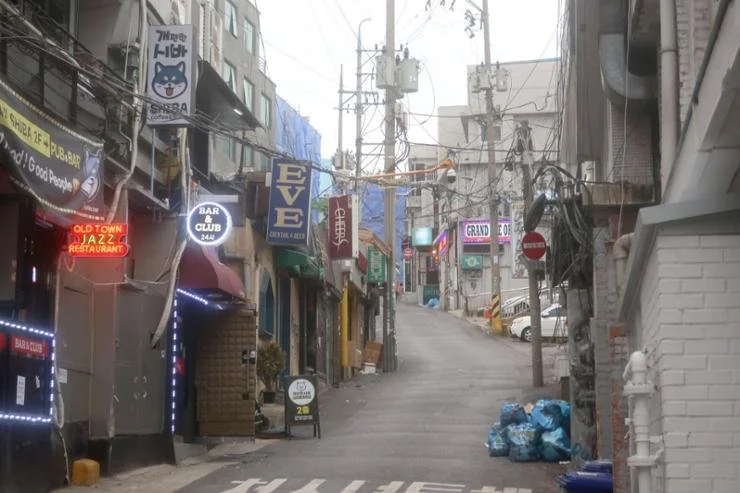
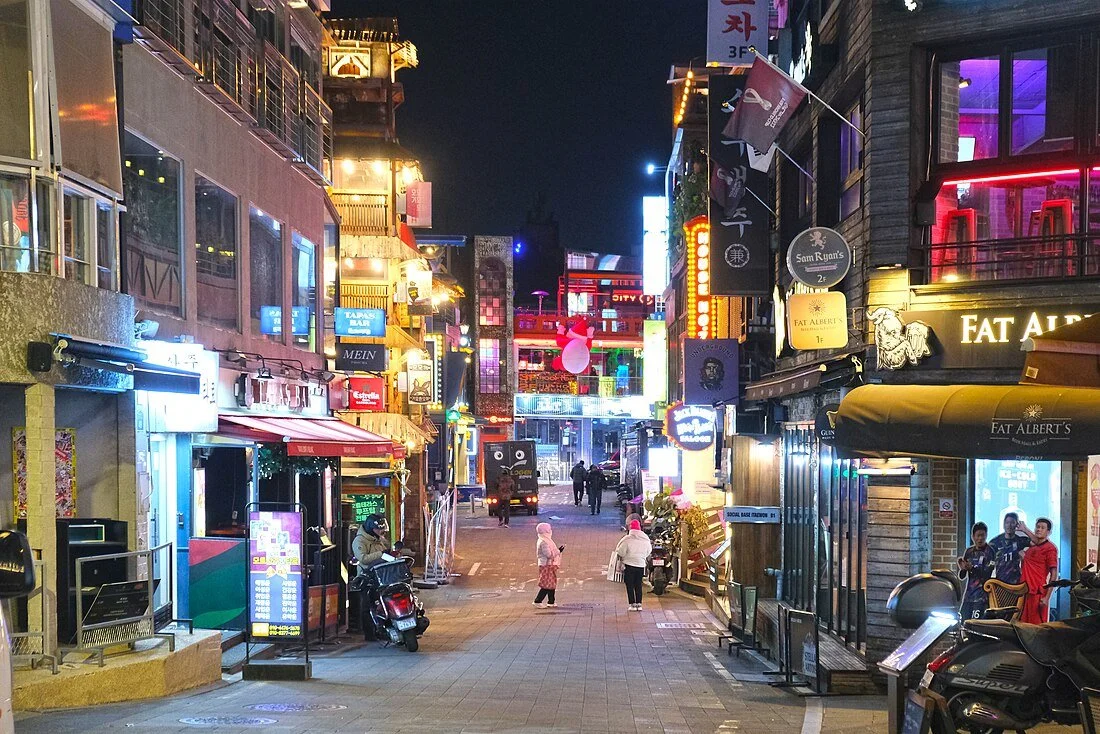
The main drag was lined with tourist shops and restaurants, and they catered to the growing tourist trade. If you wandered into the side alleys, you would find a wide variety of small bars. Here, the clientele was almost exclusively American soldiers and the ex-pats. The bars were all different, but what they had in common was a bevy of young women, waitresses. They worked for tips and drank waitress cocktails (little to no alcohol) at inflated prices while they chatted up the customers. They weren’t prostitutes, those worked the streets, but rather rural girls from poor families who earned money to send home and hopefully land a husband and escape to the West, and through chain-migration, bring the family out later.
This was a big problem for the army right after the war, in the 50s and 60s, so much so that they actively discouraged them to the point of prohibiting these marriages. Most of the GIs were young, right out of high school, and inexperienced. But by the 80s, the military changed its approach to counselling rather than forbidding this practice. And as the Korean economy grew, there was less pressure on the girls to find a way out.
But the scene persisted. There was an ever-renewing supply of eager young soldiers and not-so-young businessmen, plus a like number of girls looking for an opportunity at a better life. It was in this setting that I started Mimi on her journey.
There was one bar in particular that was very popular, but is not around anymore. It was called Sam’s Place. It was a country-western bar with picnic tables for the customers and a dance floor in the middle. The waitresses were all dressed as cowgirls with boots and blue jean shorts, and red and white plaid shirts tied up in a knot to show their midriffs. When certain songs were played, the girls would all converge on the dance floor for a little Texas Two-step or Boot Scootin’ Boogie. They were pretty good dancers.
It was this bar that I remembered when creating the place where Mimi first met Lachlan and Messer.
